ここから本文です
TWO:

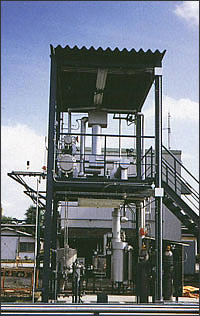
Membrane separation type solvent dehydration system

Great attention is recently being paid to global environmental issues, and it is now conceivable that companies will need to treat used solvents themselves. In consideration of this kind of social issue, we have developed a “membrane separation type solvent dehydration system,” which uses a polyimide membrane with superior dehydration properties developed by Ube Industries, Ltd. in combination with our own distillation and concentration technology that has resulted in solvents being more easily recovered.

THREE:It is, then, proved that the law which imprisons[227] subjects in their own country is useless and unjust. The punishment, therefore, of suicide is equally so; and consequently, although it is a fault punishable by God, for He alone can punish after death, it is not a crime in the eyes of men, for the punishment they inflict, instead of falling on the criminal himself, falls on his family. If anyone objects, that such a punishment can nevertheless draw a man back from his determination to kill himself, I reply, that he who calmly renounces the advantages of life, who hates his existence here below to such an extent as to prefer to it an eternity of misery, is not likely to be moved by the less efficacious and more remote consideration of his children or his relations.
  • 1Under the distillation system, even in case of azeotropic solvent compositions, this system which remove water vapor by the polyimide membrane will easily dehydrate.
  • 2In comparison with the distillation system, it significantly saves on use of steam.
  • 3Dehydration can be performed through merely supplying evaporated vapor to the membrane module and maintaining the differential pressure between the permeable side and the impermeable side.
  • 4Solvent purity of 99.9% or more can be achieved by carrying out dehydration with a polyimide membrane only.
  • 5The polyimide membrane has superior heat and solvent resistance. Therefore, the vapor permeation system reduces contamination of the membrane and thus extends its life.
THREE:The influence of the predominant French philosophy appears throughout Beccarias treatise. Human justice is based on the idea of public utility, and the object of legislation is to conduct men to the greatest possible happiness or to the least possible misery. The vein of dissatisfaction with life and of disbelief in human virtue is a marked feature of Beccarias philosophy. To him life is a desert, in which a few physical pleasures lie scattered here and there;[5] his own country is only a place of exile, save for the presence of a few friends engaged like himself in a war with ignorance. Human ideas of morality and virtue have only been produced in the course of many centuries and after much bloodshed, but slow and difficult as their growth has been, they are ever ready to disappear at the slightest breeze that blows against them.Of all the attacks which the publication of the Dei Delitti provoked, the bitterest came naturally from a theological pen. At the very time that Beccarias work appeared, the Republic of Venice was occupied in a violent contest touching the Inquisitorial Council of Ten; and imagining that Beccarias remarks about secret accusations had been directed against the procedure of their famous[16] tribunal, whilst they attributed the work to a Venetian nobleman called Quirini, they forbade its circulation under pain of death. It was on their behalf and with this belief that the Dominican Padre, Facchinei, took up his pen and wrote a book, entitled, Notes and Observations on the Dei Delitti, in which he argued, among other things, not only that secret accusations were the best, cheapest, and most effective method of carrying out justice, but that torture was a kind of mercy to a criminal, purging him in his death from the sin of falsehood.

The aromatic polyimide membrane is highly permeable to water vapor but less permeable to vapors of organic compounds such as alcohol etc.

THREE:The object of the preliminary chapters is to place the historical importance of the original in its just light, and to increase the interest of the subjects it discusses.
  • 1 Recovery of the detergent solvent Recovery of the cleaning solvent such as electronic parts industry, precision instrument industry.
  • 2Solvent recovery and the refinement Solvent recovery and the refinement such as chemical industry, an industry of medical supplies, food industry, the fermentation industry.
THREE:Such considerations as these will, perhaps, lead some day to the abolition of capital punishment. The final test of all punishment is its efficiency, not its humanity. There is often more inhumanity in a long sentence of penal servitude than in a capital sentence, for the majority of murderers deserve as little mercy as they get. The many offences which have ceased to be capital in English law yielded less to a sense of the inhumanity of the punishment as related to the crime than to the experience that such a punishment led to almost total impunity. The bankers, for instance, who petitioned Parliament to abolish capital punishment for forgery, did so, as they said, because they found by experience that the infliction of death, or the possibility of its infliction, prevented the prosecution, the conviction, and the punishment of the criminal; therefore they begged for that protection for their property which they would derive from a more lenient law. The first class of crimesthat is, the worst, because they are the most injurious to societyare those known as crimes of high treason. Only tyranny and ignorance, which confound words and ideas of the clearest meaning, can apply this name, and consequently the heaviest punishment, to different kinds of crimes, thus rendering men, as in a thousand other cases, the victims of a word. Every crime, be it ever so private, injures society; but every crime does not aim at its immediate destruction. Moral, like physical actions, have their limited sphere of activity, and are differently circumscribed, like all the movements of nature, by time and space; and therefore only a sophistical interpretation, which is generally the philosophy of slavery, can confound what eternal truth has distinguished by immutable differences.

Acetone, ethanol, methyl ethyl ketone, butanol, isopropyl alcohol, ethyl acetate, methyl isobutyl ketone, others (including hexane and toluene).